Relocity launches in Boise: Elevating talent mobility in the City of Trees | Relocity

Los Angeles, CA (March 27, 2025) – Relocity, a global leader in technology-driven talent mobility, announces the launch of its Concierge solution in Boise, Idaho. Relocity Concierge, the company’s award-winning destination services and rental search service, matches relocating employees with dedicated local experts who provide personalized support throughout the entire home finding and settling-in process. This economically vibrant "City of Trees" expands Relocity's network of markets where the company delivers personalized relocation support for professionals worldwide. Leveraging its innovative, technology-first approach through an AI-powered platform, Relocity serves Fortune 500 companies, multinational organizations, and growth-focused enterprises looking to optimize employee transitions and ensure successful talent relocation.
"The expansion of Relocity’s Concierge service into Boise meets the rising demand from companies seeking seamless, personalized relocation solutions," said William Taylor, Senior Vice President of Business Development at Relocity. "Boise's tech growth and mountain-town charm require the type of high-touch, high-tech approach that defines Relocity's Concierge services, ensuring a seamless, tailored relocation experience that aligns with the needs of employees and corporations alike.
Boise: A premier destination for global talent
Anchored by a growing tech corridor and renowned for its unparalleled mountain lifestyle, Boise consistently attracts leading talent across technology, healthcare, and manufacturing industries. As businesses relocate employees to this dynamic mountain hub, the demand for sophisticated destination services grows significantly. Relocity Concierge addresses this need by providing relocating employees and their families personalized guidance through a dedicated Personal Host, ensuring a seamless transition into the Boise community.
Why Relocity Concierge in Boise?
Relocity Concierge offers a uniquely personalized relocation experience, combining innovative technology with local expertise to streamline every step of the home finding and settling-in process. Employees receive hands-on, white-glove support, including:
- Customized, accompanied neighborhood tours
- Education guidance
- Rental assistance
- Cultural integration
- Support for international services, including local registrations and banking
Given Boise's diverse lifestyle options—from the historic North End and vibrant Downtown to family-friendly suburbs such as Meridian and Eagle—expert guidance ensures transferees and their families feel at home immediately.
Industry-leading satisfaction, proven results
With a remarkable 4.95-star satisfaction rating from thousands of successful relocations, Relocity is trusted by 25% of Fortune 500 companies, 50% of Dow Jones firms and achieves a 99.6% customer retention rate.
This impressive track record underscores Relocity's effectiveness in enhancing employee experiences during relocation, helping organizations retain top talent and maintain productivity throughout the move.
About Relocity
Relocity is a leading provider of HR tech and destinations services, offering innovative solutions that simplify corporate mobility and enhance the employee relocation experience. With a commitment to integrating technology and personalized support, Relocity serves a global clientele of enterprise companies, delivering unparalleled efficiency and ease across the relocation journey.
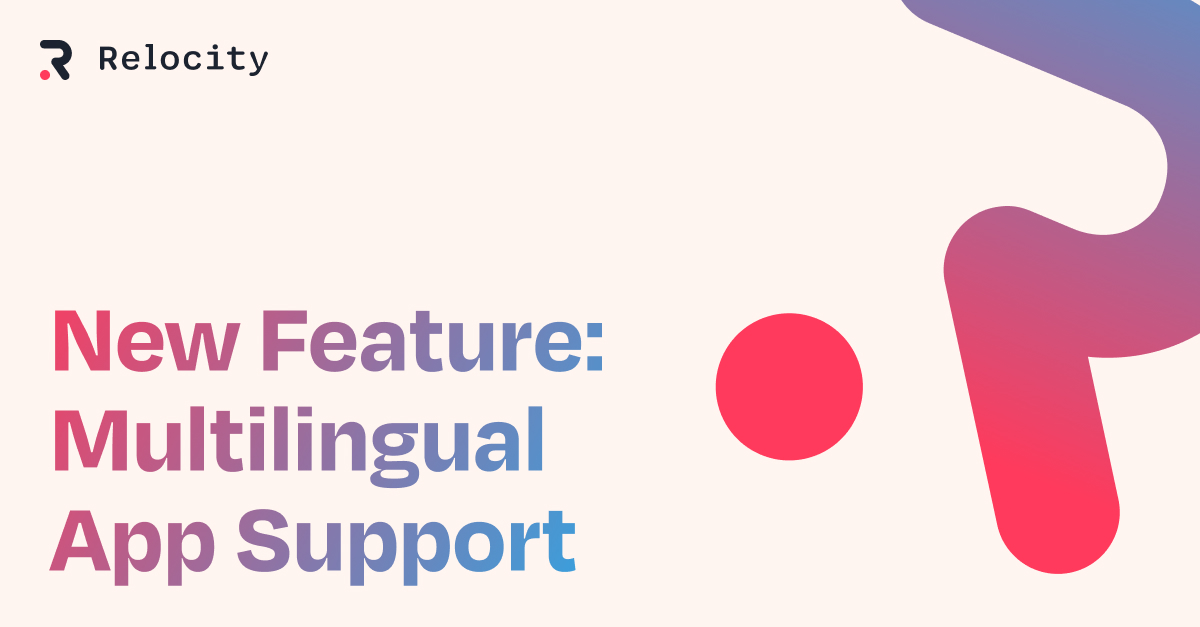
The Relocity app now works in your employees' language
10 languages now available at launch, with automatic detection and no setup required from program teams
Global mobility programs have always made a quiet assumption: that every relocating employee could navigate the relocation process in English. For many, that assumption is wrong.
An employee relocating from Mumbai, São Paulo, or Tokyo shouldn't have to work through a foreign-language app to understand their housing tasks, neighborhood guides, or next steps. A confusing experience — regardless of how well the program behind it is designed — means more support calls, missed milestones, and employees who arrive unsettled.
That assumption is now gone.
Relocity has launched multilingual support in its mobile app. Relocating employees can use the app in their own language, automatically. The app detects the device language and configures accordingly. No setup is required from mobility teams, program managers, or IT.
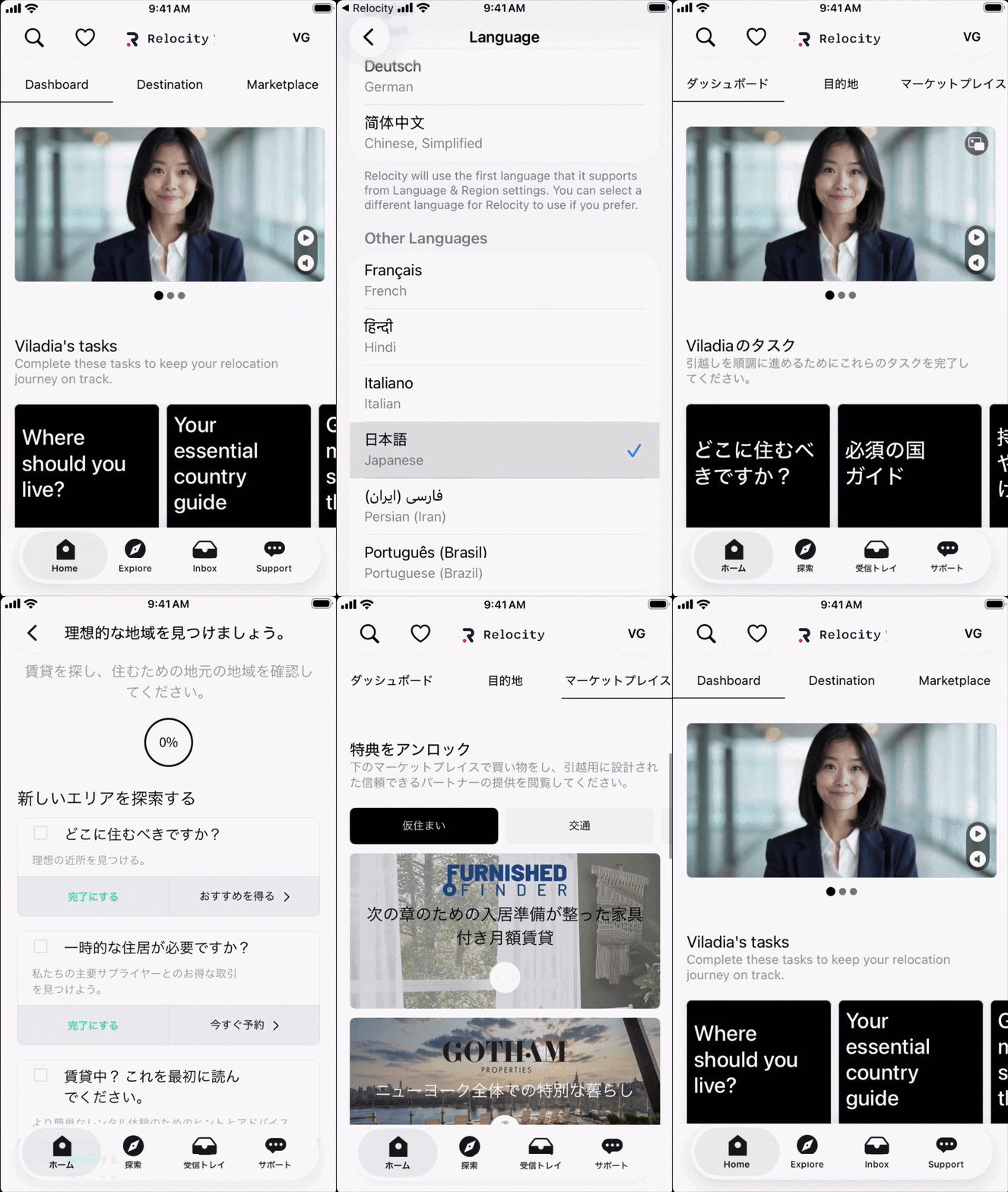
10 languages at launch
The initial release covers the most common non-English regions for global mobility programs:
German
Spanish
French
Italian
Brazilian Portuguese
Hindi
Simplified Chinese
Japanese
Farsi (with full right-to-left text support)
If a device language isn't supported yet, the app defaults to English. New languages can be added without any changes to a client's program configuration.
What gets translated
The full guided experience is available in each supported language. Translated content includes relocation goals and tasks, city and neighborhood guides, AI-assisted guide responses, service provider pages, announcement cards, and app home sections.
Chat messages, videos, and user-generated content are not translated in this release. Those are planned for a future version.
Why this matters for global programs
“Moving to a new country is one of the most personal experiences a company asks of its employees. To ensure a smooth transition, Relocity’s mobile technology is tailored to the needs of its users, including the language in which it is delivered. Relocity now provides relocating employees with a fully guided employee experience in their native language, making the process more accessible and enjoyable.”
– Klaus Siegmann, CEO & Founder, Relocity
For teams managing international populations, multilingual support has consistently come up in RFP conversations as a must-have. It's also a practical program design issue: when employees can't navigate the app confidently, the digital foundation of the program breaks down — and that workload lands back on the mobility team.
The multilingual app means the guided experience actually guides. In the employee's language, from day one.
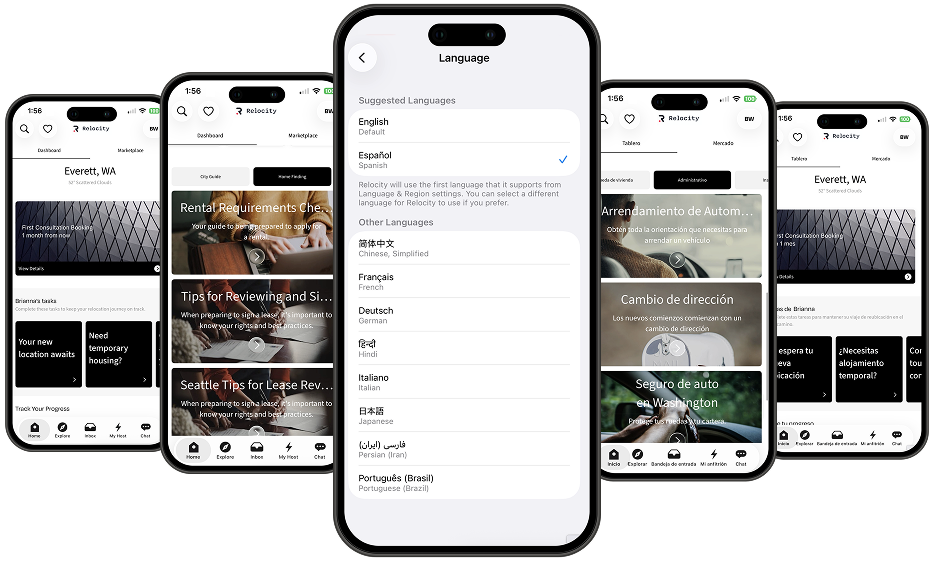
One platform for every move.
The Relocity mobile app is the employee-facing layer of the Relocity relocation experience platform. Every relocating employee uses one guided mobile experience, regardless of move type, location, or level of support. Digital guidance is always included. Mobility teams can layer in Advisor for dedicated remote support, or Concierge for a Personal Host on the ground.
Multilingual support is available now. Schedule a demo or contact the Relocity team to learn more.

The modernized relocation journey: How AI is redefining global mobility
Explore how Relocity and AI revolutionize global talent mobility with three use cases that transform employee relocations, reduce stress, and increase efficiency.
The future of global talent mobility with AI - 3 use cases
The world of global talent mobility is evolving rapidly, and at the forefront of this change is Agentic AI—an innovative technology transforming the way companies manage employee relocations. Traditional relocation methods are often time-consuming, stressful, and fragmented. However, with AI-powered solutions, companies can now offer personalized, seamless relocation experiences that reduce employee stress, increase efficiency, and ensure compliance with regulatory requirements.
In this article, we’ll explore three key use cases of how Agentic AI is reshaping the relocation journey for employees, specifically following the story of Jean Claude, who’s relocating from Paris to San Francisco with his family and pet. These advancements are not just possible—they’re happening today, and in many cases, they are already in use with Fortune 500 companies. Each use case includes a short video that shows how AI is powering this part of the experience.
Setting the Stage:
Jean Claude’s relocation journey
Jean Claude is a professional from Paris, about to relocate to San Francisco with his partner, two kids, and their dog, Charlie. He’s been offered an exciting job opportunity and is preparing for the move of a lifetime.
As Jean Claude embarks on his relocation journey, the first thing he notices is the personalized experience that comes with his relocation package. Through Relocity, an AI-driven platform, his relocation process is tailored specifically to his needs, preferences, and policies. He receives a relocation package that includes relocation benefits, a personalized relocation avatar, and curated services that will guide him throughout the entire journey.
Use case #1:
Personal AI-powered avatar as your guide (Beginning of the journey)
"84% of HR professionals consider delivering a globally consistent employee experience a top priority."
Mercer’s 2024 Employee Benefits and Technology Report
As soon as Jean Claude opens the Relocity app, he’s greeted by a personalized avatar designed to guide him through the entire relocation process. This avatar speaks French, his native language, ensuring the experience feels comfortable and personal.
“Hi Jean Claude. I’m excited to help with your move from Paris to San Francisco. Based on your policy, I see you start in 60 days and need a home and moving help that matches your budget. Use the Relocity app and ask me for help anytime, 24 hours a day.”
This is the power of Agentic AI. The avatar is more than just a static character; it is a dynamic virtual assistant that continuously adapts to Jean Claude’s needs. Powered by AI agents, it draws on various data points, such as his relocation policy, destination, family needs, and moving requirements to create a highly personalized relocation experience.
Key features & takeaways:
- AI-Powered Personalization: The avatar tailors its responses based on Jean Claude’s relocation policy, needs, destination, and budget. Each interaction is personalized to make the relocation journey smoother.
- Always-On Support: The avatar is available 24/7, offering dedicated assistance at any time, just like having a Destination Service Provider ready to help—no matter the hour.
- AI-Driven Coordination: The AI seamlessly connects and coordinates Jean Claude’s needs, offering a stress-free relocation process right from the start.
Insight
“84% of HR professionals consider delivering a globally consistent employee experience a top priority,” and the AI-powered avatar is a prime example of how such personalization is not just an enhancement, but a vital part of creating a consistent, stress-free relocation experience.
Use case #2:
24/7 AI assistance for key relocation concerns (Mid-journey)
Mercer’s Mobile Employee Wellbeing Webinar (2024)
"Two-thirds of employees say their employer cares about their health and well-being."
As Jean Claude progresses through his relocation journey, he encounters some common challenges: researching schools for his children, finding reliable movers, and figuring out how to transport his beloved pet, Charlie. But here's the twist—these are questions Jean Claude doesn’t have to wait days for answers. With Agentic AI, he has access to real-time assistance, even during off-hours.
At 2 a.m. on a Saturday, Jean Claude is able to open the app and ask questions about his son’s new school. The AI-powered chat immediately responds with curated, relevant information, suggesting schools based on his family’s preferences and location in San Francisco.
In addition to this, Relocity provides Jean Claude with a curated marketplace of suppliers—recommended movers, pet transport services, and more—all available at his fingertips. By leveraging AI agents, the app continuously gathers new data and refines the information it presents to Jean Claude, offering more relevant and personalized suggestions as he engages with the platform.
Key features & takeaways:
- 24/7 Availability: Jean Claude can get real-time answers to pressing questions, ensuring that he doesn’t have to wait for business hours.
- Curated Marketplace: The app recommends services that matter most, such as reliable movers, pet transport, and school options, based on Jean Claude’s unique needs, policy, and budget.
- Stress-Free Experience: With AI-driven personalized assistance, Jean Claude can tackle important relocation tasks without stress, even after hours.
- Compliance & Risk Mitigation: By using curated services and AI recommendations, the platform helps mitigate risks by ensuring Jean Claude is using vetted, compliant providers.
Insight:
“Two-thirds of employees say their employer cares about their health and well-being,” and by providing 24/7 AI support, the relocation experience ensures that Jean Claude has access to the help he needs, when he needs it.
Use case #3:
AI-orchestrated solutions for unexpected issues (End of the journey)
Deloitte’s 2023 Global Human Capital Trends Survey (2023)
"81% of organizations acknowledge the importance of anticipating and considering broader societal and environmental risks when making workforce decisions."
But what happens when the unexpected occurs? For example, when Jean Claude’s international flight is canceled late at night, disrupting his entire schedule? In the traditional relocation process, this could lead to hours of frantic phone calls and emails.
However, with Agentic AI and Model Context Protocol (MCP), Jean Claude’s entire relocation process is seamlessly updated in real-time. The app’s AI agents reach out to multiple service providers—rescheduling his flight, updating his temporary housing, adjusting moving schedules, and informing HR—all without Jean Claude having to lift a finger.
By leveraging MCP, Agentic AI allows platforms to communicate and collaborate seamlessly, solving complex issues quickly and efficiently. In Jean Claude’s case, this means he can rest easy, knowing his entire relocation journey is managed by AI.
Key features & takeaways:
- AI-Orchestrated Coordination: When things go wrong—like a flight cancellation—Agentic AI ensures all moving parts are updated seamlessly without manual intervention, saving Jean Claude time and frustration.
- Always-On Support: Even in the middle of the night, AI-driven solutions spring into action, ensuring 24/7 assistance when needed most.
- Stress-Free Relocation: AI handles complex scenarios, making the process hassle-free, even when the unthinkable happens.
- AI-Powered Personalization: Through curated experiences, the app ensures Jean Claude’s journey stays on track, no matter what obstacles arise.
Insight:
“81% of organizations acknowledge the importance of anticipating and considering broader societal and environmental risks when making workforce decisions.” Agentic AI helps organizations mitigate these risks by ensuring that employees like Jean Claude are supported seamlessly, even when the unexpected happens.
Conclusion
AI is not the future—it’s here now. The advancements we’ve seen in Agentic AI are revolutionizing the relocation process, offering employees a personalized, streamlined experience that reduces stress, saves time, and enhances overall satisfaction. From the very first interaction with an AI-powered avatar to solving real-time challenges like flight cancellations, AI is playing a crucial role in making global talent mobility more efficient, less stressful, and more compliant with regulatory requirements.
As companies embrace Agentic AI and Relocity for their relocation needs, they not only improve the experience for employees like Jean Claude, but they also create a more seamless, effective process that benefits everyone involved.
Key features & takeaways:
- AI-Powered Personalization: Every step of the relocation journey is tailored specifically to the employee’s unique needs, budget, and policy.
- Stress-Free Experience: With 24/7 support and AI-driven coordination, employees can feel confident that their move is in good hands, no matter the challenges.
- Always-On Support: Agentic AI is available whenever needed, providing dedicated support and real-time problem-solving to ensure smooth relocations.
- Compliance and Risk Mitigation: AI ensures compliant service providers are selected, mitigating potential relocation risks.
Take the next step in modernizing your relocation programs with Relocity.
Ready to make your relocation programs less stressful and more manageable for all (including employees and employers)? Whether it's a lump sum policy or a managed move or anything in between, Relocity can help.

Three Relocation Myths That Cost More Than They Save
Three common beliefs about relocation support drive up cost, delay, and exceptions. A look at what mobility leaders get wrong, and how to get it right.
Picture two moves in the same program. A senior director gets the full white-glove package. He's relocated four times, knows the drill, and mostly wants to be left alone. A new grad gets a login and a housing stipend, and spends her first week asking Reddit whether her lease looks normal. The program paid for help that wasn't wanted on one move and skipped the help that was needed on the other. Nobody made a bad call here. Both moves got exactly what the policy says their level gets, and neither cost shows up in a report.
Assumptions like that are built into how most programs were set up years ago. The savings are easy to see. The costs are not. Three of these assumptions come up in almost every program review, and this year they deserve a hard look.
In its 59th Annual Corporate Relocation Survey, Atlas found that 61% of companies plan to increase relocation budgets while 46% say more employees are declining offers to move. Budgets are growing, and a move that goes badly now wastes more money and makes the next employee harder to convince.
Atlas's advice is to tailor relocation to the individual instead of giving everyone the same thing. These three myths are where that tailoring usually breaks down.
Myth 1: Employees can find what they need online now, and AI can answer the rest
This one feels a little more true every month. Search is instant, AI assistants sound confident, so why pay for someone to tell an employee what a quick prompt already will?
The problem is what a search can't do. Rent averages, neighborhood lists, a week-one checklist: all of that is a click away, and it's the same answer for everyone who asks.
The questions that actually matter are different. Which school makes sense for this family, given how they live, what they value, and what they're used to? Is this lease clause standard in this city, or something to push back on? How long does that commute really take on a weekday morning, as opposed to on a map? Getting those right takes someone who knows the market and knows the family, and no search engine or chatbot knows either one.
The answers themselves aren't as reliable as they sound, either. In OpenAI's own published testing, one of its models got short factual questions wrong more than a third of the time, and accuracy drops further on narrow topics that are thinly documented online. Google's AI Overview once presented an April Fools joke as an established fact.
None of this makes AI useless. It means free AI tools come with an error rate, and a relocating employee is signing a lease and choosing a school, decisions that are expensive to undo if the information was wrong.
Relocity uses both, with a clear line between them. Every employee gets a digital foundation: city guides, a vetted marketplace, and an assistant that draws on the employer's own relocation policy and on destination content Relocity maintains and verifies, not on whatever the internet happens to say. Ask what your benefit covers, and you get the terms your company actually wrote.
For moves that include human support, a Host works with the employee's real situation, their family, their budget, their timeline.The technology handles the routine questions in seconds, and a Host is there for the decisions that follow.
Myth 2: We already work with a real estate agent, so destination support is redundant
If the employee already has an agent, it's fair to ask what the second person is for. The agent knows the market, books the showings, negotiates the deal. On paper, it's two people covering one job, and one of them can go.
The piece that's easy to miss is how agents get paid. Most agents earn on closing, which gives them a stake in whether the employee buys and in which home they choose. That's the structure of the job, not a flaw in the person doing it, and it means the person guiding one of the largest financial decisions of the move has an interest in how it ends.
A Host has none. A Host answers to the employee alone, and can say "walk away from this one" without it costing them a thing.
The decision is big enough to warrant that second set of eyes. Once commissions are included, seller closing costs have historically run 8% to 10% of the sale price, roughly $29,000 to $36,000 on a typical $362,000 US home, according to Zillow.
Scrutiny on those costs keeps rising. The National Association of Realtors settled commission lawsuits for $418 million, and the resulting rules now require buyers to sign a written agreement with their agent and negotiate the fee directly. Relocating employees now choose and pay for that representation themselves, often in a market they've never lived in, which makes independent guidance worth more, not less.
There's also a quieter coordination problem. In most moves, the agent, the relocation counselor, and the employee are each working from a slightly different picture of the same relocation. Relocity closes that gap. The Host works alongside the agent, keeps a single coordinated file, goes along on showings, and flags what the employee might not think to ask.
Myth 3: Destination support is a concierge for questions and errands
The word “concierge” is doing the myth's work. It suggests restaurant recommendations and a friendly voice for questions, welcome but skippable when budgets tighten.
Watch a good Host run a cross-border move and errands are the least of it. The real job is keeping the steps in order.
A new arrival typically can't get a Social Security number until their work authorization is active, and in many states they can't get a driver's license without documents that depend on both. That order is set by USCIS, the Social Security Administration, and the state DMV, and none of them care about your employee's start date. Take the steps out of order and the timeline slips, sometimes by weeks.
Those slips are expensive. Worldwide ERC puts the average US domestic relocation near $85,000 for a homeowner and $34,000 for a renter, with home sale assistance the single largest line. While the housing decision plays out, temporary housing runs about $161 a night, with average stays of 78 to 83 nights and most policies budgeting 30 to 90 days, so a month comes to roughly $4,800.
Every week an employee stays in temporary housing is another week the program pays for it, and another chance for an exception request to land on the mobility team's desk. SHRM's relocation guidance reaches the same conclusion from the other direction: a documented process and one point of contact remove the ambiguity that drives both cost and delay.
That's the job the Relocity platform is built for. The technology tracks the steps, with checklists, milestones, and a status the mobility team can see in real time. The Host handles the coordination and the advocacy that keep the move on schedule. When support has that structure, the results are measurable: employees reach permanent housing sooner, exceptions drop, and people arrive ready to work.
What the three have in common
Each of these myths looks like a way to spend less, and each one moves the cost somewhere harder to see: extra weeks of temporary housing, exception requests, an employee who starts off unsettled and takes longer to get productive. The savings show up in this quarter's budget. The costs show up a quarter or two later, in line items nobody thinks to trace back this far.
Support should scale to what the person and the move require, not to someone's job level or an assumption the program inherited. Relocity was built for exactly that: one guided experience for every relocating employee, human support added where it's needed, and a single place where the mobility team sees every move.
See it in your own program
If any of these sound familiar, it's worth seeing the alternative in practice. Schedule a demo and the Relocity team will walk you through the platform: what employees see, how human support gets added, and the live view your team has of the whole program.
Schedule a demo or contact the Relocity team to learn more.
See what your mobility program looks like with Relocity.
Book a demo and see how Relocity works with the program, the partners, and the employees you already have.
