Is lump sum enough? A post-panel conversation on the future of relocation
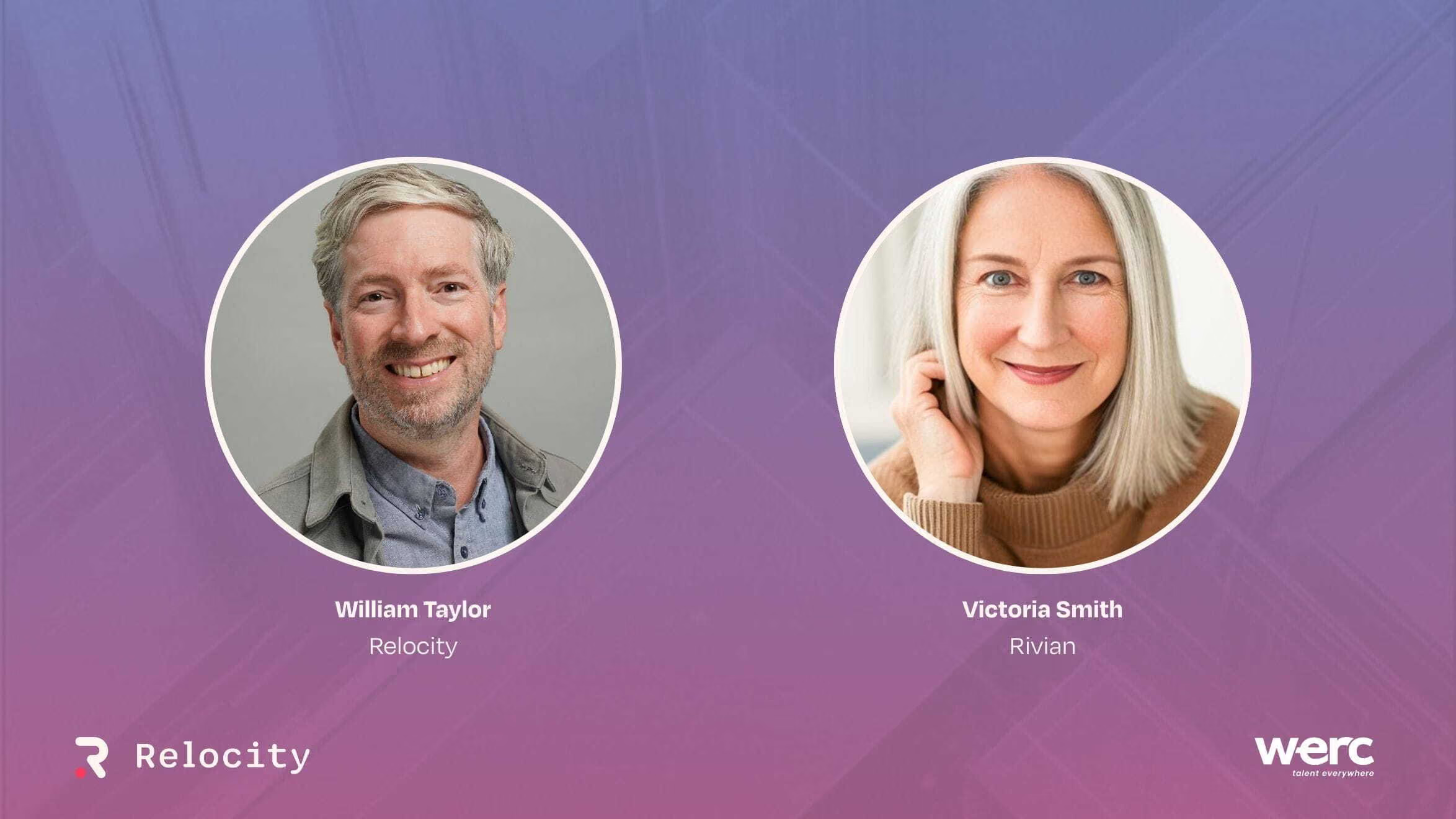
WERC's Director of Content Alexa Schlosser sits down with William Taylor, SVP of Business Development at Relocity, and Victoria Smith, Senior Global Mobility Manager at Rivian, right after their session at WERC Global ‘25. Watch on Youtube.
Key Takeaways: The Future of Lump Sum Relocation
Why Lump Sums Remain Controversial
- The traditional relocation industry was built around managed moves, and RMC business models depend on that approach
- Lump sums disrupt established supply chains and revenue models, creating natural resistance
- The debate reflects a fundamental tension between traditional service models and modern employee preferences
The Case for Lump Sums
- Budget predictability: Finance teams know exactly what relocation will cost
- Employee empowerment: 75-80% of eligible Rivian employees chose lump sum when given the option, and most would do so again
- Maximized ROI: Employees who see the costs make smarter spending decisions; traditional benefits often go undervalued because employees don't see the price tag
- Modern workforce expectations: Today's employees are used to self-service—booking their own travel, tracking shipments, managing their own logistics
The Hybrid Reality
- Only 2-3% of companies run 100% lump sum programs
- 83-85% of companies surveyed use a hybrid approach
- Even tech-forward companies like Rivian maintain managed move options for senior leaders and international assignments
- Giving employees the choice between cash and managed services respects their autonomy
What Good Lump Sum Programs Look Like
- Offer choice rather than mandating one approach
- Layer in targeted support benefits (rental assistance, destination services, short-term housing) that aren't overly expensive but improve experience
- Survey employees on satisfaction, not just whether the amount was "enough," but how they felt about the experience
- Trust that adults can make good decisions for their own families
Looking Ahead
- Gen Z and Gen Alpha will accelerate the shift toward self-service and app-based solutions
- Economic conditions will influence trends: downturns push companies toward lump sums; tight labor markets may favor richer packages
- Technology will continue enabling better self-service experiences
- The term "lump sum" itself may need rebranding, it carries negative connotations despite delivering positive outcomes
Bottom Line
Lump sum isn't about abandoning employees. It's about trusting them. The data shows employees feel more empowered when they control their relocation spending, and companies get better ROI when every dollar goes toward what the employee actually values. The future isn't lump sum vs. managed moves; it's smart hybrid programs that offer flexibility while maintaining duty of care.
Full Interview Transcript:
Alexa Schlosser: We're here at WERC Global in Salt Lake City, fresh off the lump sum panel from about an hour ago—the highly contested topic of lump sums. I have here with me two out of the three panelists today: William Taylor from Relocity and Victoria Smith from Rivian, who manages the global mobility program. Unfortunately, Trisha from Adobe had other obligations, so feel free to throw her under the bus.
Victoria Smith: She just nominated me to speak on her behalf.
Alexa: Just to get us started, the session made clear that there's really no one-size-fits-all approach to relocation. Yet the debate clearly struck a nerve—it strikes a nerve whenever it's brought up anywhere. Why does this conversation about lump sums continue to be such a hotly contested and polarizing one?
William Taylor: I think this is an industry that grew up on traditional moves, managed moves, real estate components. Many pieces of the supply chain were built to support those more traditional type of programs. If you think about how the RMCs operate, this is how their business model was built. And then along came this program called lump sums, cash benefits, and it delivers more flexibility, more personalization, more predictability of spend. Finance likes it because they know exactly what we're going to budget for next year. If we're going to do this many lump sums, we know exactly what they're going to cost. Ease of administration, all those factors.
That's just created a difficult paradigm for the folks who've been in our space for many years, for the RMCs. We have this push and pull where people just need to get over that hurdle to realize that lump sum is not a one-size-fits-all, but as we heard during the session—and Victoria can speak to this—it's more about figuring out who are the populations that would benefit. How do you mix this in and offer some flexibility and some cash-out options to give people that personalized approach? I think the RMCs are starting to figure out how to create that, though there's a missing piece that's more supply chain related.
Victoria: I agree. The world has changed. People are so much more global. Relocating isn't as big a deal as it used to be. It's still disruptive to your family, absolutely, but people are so much more global. So many people that we bring in have relocated before—it's not their first time. And there's so much information just out there. It's not like it was 25 years ago when you were kind of going to unknown locations. People are so used to managing everything themselves these days. They're booking their own tickets, tracking their shipments on their phone. They have that agency to want to do things for themselves. Access to information is essentially free.
William: Back in the day, I traveled in Southeast Asia. I lived in Vietnam in the late '90s and it was all about the Lonely Planet guide. I carried these massive books around. My wife and I moved there for a few years—we didn't have a relocation management company, we didn't have a real package.
Victoria: I did the same when we moved to Argentina. We didn't have an RMC. But we had resources and we figured it out, and now the accessibility of those types of resources is just so prevalent. It's not to say that there's not a place for managed moves—there absolutely is—but I think we will continue to see lump sums play an important role in mobility programs.
Alexa: During the session you asked the audience a lot of polls using Slido. Did anything surprise you from the results, or was it all sort of what you expected to see?
Victoria: I think there's a general perception that people use cash but that it can't deliver a good experience. What we've certainly found in our population is that a good experience doesn't always have to be a white-glove service. People like to make their own decisions. They like to be empowered to make the choices and to do things their own way.
We find that self-service isn't a dirty word. It doesn't mean that we're not supporting and looking after our population—we do have a level of duty of care to them—but we're also not imposing on them. This is how you have to relocate, you must have a car to ship, you must need accommodation. They can make those choices for themselves.
Alexa: You both mentioned "we hire adults" several times. I think everyone in the room hires adults and we should expect that they make the right decisions and take accountability. You and Trisha both talked about more of a hybrid model where it's not like "we give you cash, you have to go on your own now." It's not just throwing people to the wolves. For senior leaders, you still do some managed services.
Victoria: Absolutely. And even further down into the organization, for that middle layer, we just let them choose. Do you want cash and some technology and manage this yourself, or do you want to be more handheld and have things organized for you? We let them make that decision. There's no pressure one way or the other—it's just whatever works for you. Whilst I've been in mobility for a long time, I don't know what is right for your family and your particular situation right now. You know that. You make that decision. I don't want to make it for you just because I run the program.
William: You captured the way we have often framed relocation in this industry. I think this is partially why Relocity has been so successful since we were created nine years ago. We came along and said there's a better way to personalize this experience—let's give the power to the transferee.
We've had this mindset in mobility of "we know what's best, we've done it for 30, 40, 70 years, this is what you need." Yet that is just not the world we live in. We have a full aisle in the grocery store dedicated to potato chips because people enjoy 400 different flavors. If people can choose their chips, they can probably choose the right benefits as it relates to their relo. I know, very different worlds—chips versus relo—although I'm here to be the first one to bring them all together.
Alexa: Victoria, you and Trisha both talked about the culture of your organizations. Rivian is obviously a tech company, Adobe as well, so the culture and demographic might lend itself better to a lump sum option. What about maybe some of the perspectives that weren't on the panel today, like a more traditional company? Are they still going toward lump sum, or is it agnostic of the type of company?
Victoria: In tech companies, it's much more driven through the whole culture of the organization to experiment, try different things. That's a freedom and an expectation that we have of our people—to problem solve and solutionize. We're not here to be your parents and take care of all of your issues for you.
But at the end of the day, people who are relocating are just people who are relocating. We consider ourselves a tech company, but we're also an automotive manufacturer, so we have many populations within our organization. We want them to be able to make the right decisions, which isn't so much about what job you do. We're really looking through our mobility programs to continue the adventurous spirit that is Rivian, and we're very blatant about that.
William: If you think about the poll that asked about the nature of your program—is it whole lump sum, hybrid, a mix—we saw that 83-85% were hybrid lump sum with some form of management, yet it was only 2-3% that were 100% lump sums. Looking across the room during the session, we had manufacturing, biotech, pharma, high-tech—folks from all different flavors of companies addressing that question. It's clear that lump sum is here to stay. There are different evolutions of it, different platforms coming up to support it and provide that experience. I'm excited to see where it all goes.
Alexa: Something important that came out of the discussion was the data you leaned on for Rivian specifically. Obviously it's cost-effective for Rivian to offer lump sum, but the data also showed that 75-80% of eligible employees chose that option. And when you followed up, a percentage would have done so again. I think the audience was kind of shocked by that. Why do you think they were so shocked?
Victoria: I was shocked when I first saw the data because it was higher than I was expecting. We really weren't sure when we gave cash whether people would be—I wasn't so much surprised by people choosing cash over a managed move. But how did they feel afterwards? I think that's the most important question in the survey.
At the end of the day, we just continue to hear the feedback that people like to feel empowered to make their own choices. They like the flexibility that it brings.
Another really important thing for us about cash lump sums is that yes, there is a cost element, and that's important. What companies aren't looking to reduce relocation spend? But to us, it's not just about the absolute dollars. It was really about how do we maximize the return on investment for every relocation dollar we're spending.
It really became apparent very quickly that people don't always value some of the benefits they were being provided. They don't have visibility to the cost of their shipment or their temporary housing. Had they known—and when they do have visibility—sometimes they come back and say, "Had I known, I would have made different choices." Giving people cash really did change the spending behavior. We now know, because people are deciding what to do with it, they're getting maximum value for whatever that means for them.
Alexa: Who am I to disagree as to whether it would have been more valuable if you'd shipped goods rather than buying new ones?
Victoria: Exactly. That for us was just a real way of getting return on investment.
Alexa: You mentioned that Rivian doesn't track the spending. How do you maintain confidence that the program is still delivering value? You're offering an amount but not asking them to tell you what they spent it on. How do you know that amount is going to maintain what it should for your business and for the employee?
Victoria: We survey the employees and we get feedback. If we ask "was it enough?" I expect to hear no—people always need more. "Was it too much?" We don't get a lot of that feedback. But I think we would hear noise, and a lot more noise. Yes, sometimes we get people coming back and saying they ended up spending more—I don't know whether that's because of some of the choices they made. But on the whole, we don't get a ton of noise and feedback of people saying "this isn't it" or "I'm not going to relocate if that is the package." That's just not the experience that we've had.
Alexa: If it's working for the business and it's working for them, why does it matter what exactly they spent on moving their bed to wherever they're going?
Victoria: Yes. Or buying a new bed. Or doing whatever.
Alexa: I've got one more question. What is one misconception about lump sums or managed moves you'd most like to see the industry move past today? Are we still going to be having this conversation in two years, five years, ten years? Is lump sum just going to become the norm? Is it still going to be this hybrid approach?
William: Look, I think we'll still have this debate for a few more years—maybe five, ten, maybe more, maybe forever. But the industry will come to accept the fact that a lump sum is not a negative experience. You can still provide a great experience because you're addressing the need for flexibility, personalization, you're hiring adults, they take responsibility, and there's so many tools out there for them to figure it out. When you bring in some of the great technology that's evolving in the world of mobility, you can really start to create this really modern consumer experience.
There's no denying a managed move is a great experience, particularly when you don't know what the costs are. But we are all stewards for our company, and as much as I love the work that our friends in household goods and temp housing do, there is definitely a reason why those types of services have a certain cost associated with them.
I just think we are going to continue to see an evolution of different hybrid programs where these flexible cash-out options become really prevalent. We will see more and more employees—particularly as the workforce becomes heavy on Gen Z and then Gen Alpha—who are pretty comfortable doing things in an app and getting things done on their own. They're really resourceful; that's the world they've grown up in. Not to say they won't get to a point in their life where they will value that really high-touch white-glove service—we'll pick you up at the airport, we'll help you buy or sell a home. They will. Or maybe not. I just think it's going to be a mix of a lot of different flavors in the years ahead with no right or wrong.
Alexa: You made a joke at the beginning of the session about how "lump sum" is just a bad word. Maybe there's a branding problem.
William: We've got a lot of branding problems in this industry.
Alexa: That's a question we should have asked—what should it be called?
William: We could have a word cloud. Maybe a few years from now we're having the same discussion but calling it something else. I mean, it's a cash benefit. I don't know what else we'd call it. I don't even know where the evolution of the term "lump sum" came from—I tried to look it up but couldn't find a clear answer. At least ChatGPT failed on that one. But yeah, we need to rebrand that and make it sound a little more attractive.
Victoria: I'm with you. Our cash lump sums have been very effective for our populations and for what we're doing. But nothing stays static. We absolutely do managed moves. Do I see a world in which we would stop doing those? No.
I think we did make the point that it is somewhat different moving into the US or whatever location companies are headquartered in versus sending people out to perhaps some more challenging locations to move to. You absolutely need the whole spectrum.
I do see that as the economy changes—typically when there's an economic downturn, there's more movement towards lump sums. In times of prosperity and very tight labor markets when you're all competing for the same talent, that may be where a richer relocation package may make the difference. I'm not a huge proponent of that. I like people to join for the job rather than the relo package. But there can be a time where those things can be differentiators.
None of this is static in my opinion. Certainly on the program that we have, I think we want to be able to service a broad spectrum of employees and also meet the needs and the business reality of what we have to spend.
Alexa: Any final thoughts, William?
William: We hit it. It's an ever-evolving industry and the policies and programs will continue to change. It's been really interesting and fun learning from Rivian and Adobe and hearing their experience. You guys both had some different approaches and different theories—net versus gross payroll—and that was okay. Every company is going to look at this in the context of what's most important to their company and their populations.
What will be fun to see—and we talked a little bit about this as the session ended—is how do we start to layer in some benefits that may not be too costly but can still make a little bit of an impact? Whether it's rental support or a DSP or maybe five days in a hotel, whatever it might be that's not incredibly expensive but starts to really move the needle a little further on the employee experience.
Victoria: It's a great point.
Alexa: Well, thank you both for joining me here today and for doing the panel at WERC Global. I hope you had a great time. I certainly did.
William: Thanks, Alexa.
Victoria: Thank you.

Three Relocation Myths That Cost More Than They Save
Three common beliefs about relocation support drive up cost, delay, and exceptions. A look at what mobility leaders get wrong, and how to get it right.
Picture two moves in the same program. A senior director gets the full white-glove package. He's relocated four times, knows the drill, and mostly wants to be left alone. A new grad gets a login and a housing stipend, and spends her first week asking Reddit whether her lease looks normal. The program paid for help that wasn't wanted on one move and skipped the help that was needed on the other. Nobody made a bad call here. Both moves got exactly what the policy says their level gets, and neither cost shows up in a report.
Assumptions like that are built into how most programs were set up years ago. The savings are easy to see. The costs are not. Three of these assumptions come up in almost every program review, and this year they deserve a hard look.
In its 59th Annual Corporate Relocation Survey, Atlas found that 61% of companies plan to increase relocation budgets while 46% say more employees are declining offers to move. Budgets are growing, and a move that goes badly now wastes more money and makes the next employee harder to convince.
Atlas's advice is to tailor relocation to the individual instead of giving everyone the same thing. These three myths are where that tailoring usually breaks down.

Myth 1: Employees can find what they need online now, and AI can answer the rest
This one feels a little more true every month. Search is instant, AI assistants sound confident, so why pay for someone to tell an employee what a quick prompt already will?
The problem is what a search can't do. Rent averages, neighborhood lists, a week-one checklist: all of that is a click away, and it's the same answer for everyone who asks.
The questions that actually matter are different. Which school makes sense for this family, given how they live, what they value, and what they're used to? Is this lease clause standard in this city, or something to push back on? How long does that commute really take on a weekday morning, as opposed to on a map? Getting those right takes someone who knows the market and knows the family, and no search engine or chatbot knows either one.
The answers themselves aren't as reliable as they sound, either. In OpenAI's own published testing, one of its models got short factual questions wrong more than a third of the time, and accuracy drops further on narrow topics that are thinly documented online. Google's AI Overview once presented an April Fools joke as an established fact.
None of this makes AI useless. It means free AI tools come with an error rate, and a relocating employee is signing a lease and choosing a school, decisions that are expensive to undo if the information was wrong.
Relocity uses both, with a clear line between them. Every employee gets a digital foundation: city guides, a vetted marketplace, and an assistant that draws on the employer's own relocation policy and on destination content Relocity maintains and verifies, not on whatever the internet happens to say. Ask what your benefit covers, and you get the terms your company actually wrote.
For moves that include human support, a Host works with the employee's real situation, their family, their budget, their timeline.The technology handles the routine questions in seconds, and a Host is there for the decisions that follow.
Myth 2: We already work with a real estate agent, so destination support is redundant
If the employee already has an agent, it's fair to ask what the second person is for. The agent knows the market, books the showings, negotiates the deal. On paper, it's two people covering one job, and one of them can go.
The piece that's easy to miss is how agents get paid. Most agents earn on closing, which gives them a stake in whether the employee buys and in which home they choose. That's the structure of the job, not a flaw in the person doing it, and it means the person guiding one of the largest financial decisions of the move has an interest in how it ends.
A Host has none. A Host answers to the employee alone, and can say "walk away from this one" without it costing them a thing.
The decision is big enough to warrant that second set of eyes. Once commissions are included, seller closing costs have historically run 8% to 10% of the sale price, roughly $29,000 to $36,000 on a typical $362,000 US home, according to Zillow.
Scrutiny on those costs keeps rising. The National Association of Realtors settled commission lawsuits for $418 million, and the resulting rules now require buyers to sign a written agreement with their agent and negotiate the fee directly. Relocating employees now choose and pay for that representation themselves, often in a market they've never lived in, which makes independent guidance worth more, not less.
There's also a quieter coordination problem. In most moves, the agent, the relocation counselor, and the employee are each working from a slightly different picture of the same relocation. Relocity closes that gap. The Host works alongside the agent, keeps a single coordinated file, goes along on showings, and flags what the employee might not think to ask.
Myth 3: Destination support is a concierge for questions and errands
The word “concierge” is doing the myth's work. It suggests restaurant recommendations and a friendly voice for questions, welcome but skippable when budgets tighten.
Watch a good Host run a cross-border move and errands are the least of it. The real job is keeping the steps in order.
A new arrival typically can't get a Social Security number until their work authorization is active, and in many states they can't get a driver's license without documents that depend on both. That order is set by USCIS, the Social Security Administration, and the state DMV, and none of them care about your employee's start date. Take the steps out of order and the timeline slips, sometimes by weeks.
Those slips are expensive. Worldwide ERC puts the average US domestic relocation near $85,000 for a homeowner and $34,000 for a renter, with home sale assistance the single largest line. While the housing decision plays out, temporary housing runs about $161 a night, with average stays of 78 to 83 nights and most policies budgeting 30 to 90 days, so a month comes to roughly $4,800.
Every week an employee stays in temporary housing is another week the program pays for it, and another chance for an exception request to land on the mobility team's desk. SHRM's relocation guidance reaches the same conclusion from the other direction: a documented process and one point of contact remove the ambiguity that drives both cost and delay.
That's the job the Relocity platform is built for. The technology tracks the steps, with checklists, milestones, and a status the mobility team can see in real time. The Host handles the coordination and the advocacy that keep the move on schedule. When support has that structure, the results are measurable: employees reach permanent housing sooner, exceptions drop, and people arrive ready to work.
What the three have in common
Each of these myths looks like a way to spend less, and each one moves the cost somewhere harder to see: extra weeks of temporary housing, exception requests, an employee who starts off unsettled and takes longer to get productive. The savings show up in this quarter's budget. The costs show up a quarter or two later, in line items nobody thinks to trace back this far.
Support should scale to what the person and the move require, not to someone's job level or an assumption the program inherited. Relocity was built for exactly that: one guided experience for every relocating employee, human support added where it's needed, and a single place where the mobility team sees every move.
See it in your own program
If any of these sound familiar, it's worth seeing the alternative in practice. Schedule a demo and the Relocity team will walk you through the platform: what employees see, how human support gets added, and the live view your team has of the whole program.
Schedule a demo or contact the Relocity team to learn more.

Relocity launches in Boise: Elevating talent mobility in the City of Trees | Relocity
Boise consistently attracts leading talent across technology, healthcare, and manufacturing industries.
Los Angeles, CA (March 27, 2025) – Relocity, a global leader in technology-driven talent mobility, announces the launch of its Concierge solution in Boise, Idaho. Relocity Concierge, the company’s award-winning destination services and rental search service, matches relocating employees with dedicated local experts who provide personalized support throughout the entire home finding and settling-in process. This economically vibrant "City of Trees" expands Relocity's network of markets where the company delivers personalized relocation support for professionals worldwide. Leveraging its innovative, technology-first approach through an AI-powered platform, Relocity serves Fortune 500 companies, multinational organizations, and growth-focused enterprises looking to optimize employee transitions and ensure successful talent relocation.
"The expansion of Relocity’s Concierge service into Boise meets the rising demand from companies seeking seamless, personalized relocation solutions," said William Taylor, Senior Vice President of Business Development at Relocity. "Boise's tech growth and mountain-town charm require the type of high-touch, high-tech approach that defines Relocity's Concierge services, ensuring a seamless, tailored relocation experience that aligns with the needs of employees and corporations alike.
Boise: A premier destination for global talent
Anchored by a growing tech corridor and renowned for its unparalleled mountain lifestyle, Boise consistently attracts leading talent across technology, healthcare, and manufacturing industries. As businesses relocate employees to this dynamic mountain hub, the demand for sophisticated destination services grows significantly. Relocity Concierge addresses this need by providing relocating employees and their families personalized guidance through a dedicated Personal Host, ensuring a seamless transition into the Boise community.
Why Relocity Concierge in Boise?
Relocity Concierge offers a uniquely personalized relocation experience, combining innovative technology with local expertise to streamline every step of the home finding and settling-in process. Employees receive hands-on, white-glove support, including:
- Customized, accompanied neighborhood tours
- Education guidance
- Rental assistance
- Cultural integration
- Support for international services, including local registrations and banking
Given Boise's diverse lifestyle options—from the historic North End and vibrant Downtown to family-friendly suburbs such as Meridian and Eagle—expert guidance ensures transferees and their families feel at home immediately.
Industry-leading satisfaction, proven results
With a remarkable 4.95-star satisfaction rating from thousands of successful relocations, Relocity is trusted by 25% of Fortune 500 companies, 50% of Dow Jones firms and achieves a 99.6% customer retention rate.
This impressive track record underscores Relocity's effectiveness in enhancing employee experiences during relocation, helping organizations retain top talent and maintain productivity throughout the move.
About Relocity
Relocity is a leading provider of HR tech and destinations services, offering innovative solutions that simplify corporate mobility and enhance the employee relocation experience. With a commitment to integrating technology and personalized support, Relocity serves a global clientele of enterprise companies, delivering unparalleled efficiency and ease across the relocation journey.

Healthcare talent mobility is due for a checkup—Here’s how to modernize It | Relocity
Outdated relocation processes hurt hiring & retention in healthcare. Modern mobility isn’t a perk—it’s a necessity.
Why talent mobility needs a refresh
Healthcare organizations invest significant time and resources in attracting top talent. But what happens when the relocation process—meant to welcome new hires—turns into a logistical nightmare?
For many HR and talent teams, employee relocation remains a manual, complex, and frustrating experience. Decentralized processes, lack of real-time data, and administrative burdens don’t just slow things down; they impact hiring, retention, and employee satisfaction.
With increasing competition for healthcare professionals and rising costs, organizations can’t afford outdated relocation processes. It’s time to rethink how talent mobility works and create a system that benefits both employees and HR teams.
This article explores:
• Challenges facing healthcare relocation today
• Why the need for modernization is more urgent than ever
• Practical steps HR leaders can take to improve their talent mobility programs
The current state of talent mobility in healthcare
Most healthcare organizations handle relocation in one of two ways: they manage it in-house with fragmented processes, or they outsource it while maintaining limited visibility into the employee experience. Neither approach is flawless, and common challenges persist:
1. Decentralized & overcomplicated
Many hospitals and healthcare organizations use separate departments, multiple vendors, or ad hoc processes for relocation. The result? Inconsistencies, delays, and unnecessary complexity that make it harder to deliver a smooth employee experience.
2. Limited visibility & data gaps
HR teams often lack real-time insights into relocation progress, making it difficult to track costs, measure efficiency, or identify pain points. Recent trends are indicating the need for data and technology to help connect the dots. Without data, continuous improvement is nearly impossible.
3. Employee experience challenges
Relocating is already a stressful life event. When employees lack structured support, they experience uncertainty, miscommunication, and frustration. 64% of employees are likely to leave a new job within their first year after having a negative onboarding experience.
4. HR teams are stretched thin
HR professionals juggle multiple priorities—from recruitment to compliance—leaving little bandwidth to manage relocation logistics effectively. Without the right tools and support, relocation becomes an administrative burden rather than a strategic advantage.
Why modernization can’t wait
If these challenges feel familiar, you’re not alone. Many healthcare organizations are realizing that outdated relocation processes no longer work. Here’s why modernizing talent mobility is now a necessity:
1. The talent shortage is real
By 2031, the U.S. is expected to face a shortage of 195,400 nurses and 87,150 primary care physicians (HRSA). Organizations with streamlined relocation programs have a clear advantage in attracting top talent who are weighing multiple offers.
2. Employee expectations have changed
Today’s workforce expects transparency, personalization, and structured support throughout the relocation process. A poor experience can lead to second thoughts about an offer—or early turnover. 30% of new hires leave within the first 90 days due to unmet expectations.
3. Rising costs & inefficiencies
Manual processes, delays, and last-minute changes don’t just create headaches; they drive up costs. The average company spends $97,166 per relocated employee (if a homeowner, and $24,000 if renting), yet inefficiencies and avoidable expenses significantly impact budgets.
How healthcare organizations can build a modern relocation program
The good news? Modernizing talent mobility doesn’t require a complete overhaul—it starts with strategic improvements. Here’s how HR and talent teams can make meaningful changes:
Step 1: Take a hard look at your current approach
Assess your existing process:
• How do employees experience relocation today?
• Where do bottlenecks occur?
• Are HR teams spending too much time managing logistics? Identifying inefficiencies is the first step to improvement.
• What are the current budgets/costs? (Partner with your finance team early.)
Step 2: Learn from other industries
Industries like tech, finance, and consulting have embraced modern, data-driven mobility solutions. Healthcare can adopt best practices to create a more efficient and employee-friendly relocation experience.
Step 3: Leverage the right tools & partnerships
The right mix of technology, automation, and external expertise can significantly reduce administrative burdens while improving the employee experience. Whether through outsourcing, hybrid models, or better internal systems, investing in smarter tools pays off in efficiency and satisfaction.
Step 4: Make employee experience the priority
A smooth relocation isn’t just about logistics—it’s about making employees feel valued. Small improvements, like clearer communication, personalized support, and proactive problem-solving, can make a huge difference in engagement and retention.
Final thoughts & next steps
Healthcare organizations are facing new workforce challenges, and outdated relocation processes can’t keep up. The organizations that modernize talent mobility will gain a competitive edge—those that don’t may struggle to attract and retain top talent.
So, where do we go from here?
Join our upcoming webinar, where experts from Children’s Hospital Los Angeles, Ace Relocation Systems, and Relocity will share real-world strategies for building a modern talent mobility program.
Don’t miss this opportunity to learn from leaders in the field. Sign up now and take the first step toward a more efficient, employee-friendly relocation process.
See what your mobility program looks like with Relocity.
Book a demo and see how Relocity works with the program, the partners, and the employees you already have.
